
The Silent Contract
A look at the unspoken economic realities shaping the industry: unpaid labour, invisible work, scope creep, budget anxiety and the growing gap between expectations and compensation.

You’re on an intro call. It’s going well. The brief is interesting. There’s chemistry. And at some point someone is going to have to mention the budget. Who will it be?
This article dives into the terrific(ally awkward) topic of money and the secret costs to agencies that so often go unacknowledged.
Every client-agency relationship runs on two contracts. One is written down: the SOW, the day rate, the deliverables schedule. The other isn't written anywhere - and it's the one that actually determines whether the relationship survives. Who absorbs the unpaid pitch rounds. Who eats the scope creep. Who pays the education tax. Who carries the anxiety of a budget that was never really enough. And who is up at 2am freaking out about cash flow.
This is the silent contract agencies bear.

Remarkably, across the 30+ responses gathered from senior voices at leading brands and agencies for this series, “budget” appeared ten times in agency responses, and once in the client responses. That’s not to say clients aren’t aware of it, or feeling the pinch. Both sides are navigating the same economic reality. But one side had a lot more to say about money than the other. So let’s say it.
Starting with the most infamous pinch-point of all: pitching.
This is the fourth article in a seven-part series produced in collaboration with Post-Culture by Sibling Studio, drawing on original research from 30+ senior voices across some of the world’s most respected brands and agencies.
Pitching for free: the industry’s open wound
This article isn’t where the pitch process gets its full reckoning, we’ll come to that next week, but it’s worth pausing on one piece of it here, because it sits squarely inside the silent contract: nobody pays for the thinking that goes into winning the work in the first place.
Liam S. Gleeson, Founder and Creative Director of Hidden Agency and Hi-fi.london made the case for the alternative: “Clarity on the value of the pitch itself, a willingness to invest in the thinking. When brands are upfront about compensating agencies for pitch work, it leads to more focused, higher-quality ideas and ultimately a stronger partnership from day one.”
Paid thinking is invested thinking. When the work is compensated, even modestly, the incentive shifts from impressing a room to actually solving the problem.
The bottom line is agencies shouldn’t be expected to open their brains at their own expense. I’ve seen incredible indie, boutique and independent agencies come close to going under because they’ve pitched in “good will” to brands, then weren’t selected due to a “change of direction” only for their work to go live months later through a cheaper delivery agency, or internal team.
Good clients don’t do this. They pay for the pitch.
Can we stop dancing around budgets?
The simplest clause in the silent contract is also the most avoidable. Somebody has a number in mind. Nobody says it.
Lesley Winterbach, Founder of The GOODList, put it as a direct ask: “Can we stop dancing around budgets and day rates? If you know what you can pay, say it from the start. Rate and salary transparency makes the whole process better for everyone.”
The dance is familiar to anyone who has sat in a first call where neither side will name a number first. Neither wants to overpay, or underprice. So both circle the figure for hours, weeks even. It’s a tax on time that nobody bills for.
I understand clients don’t want to overpay, and the view might be that agencies should “know” what it costs for them to make X, Y and Z. But I think we’re confusing walking into a shop to buy a mass-produced off the shelf suit with one that’s been designed and fitted bespoke to us by a boutique tailor. The former requires no brief and a price tag from the “supplier”. The latter requires a bespoke brief and budget from the “consumer”.
“Want something unique?” “Mais oui!”. Then it’s on you to name your budget.
But what if clients genuinely don’t know what their budget is? Then there are two distinct avenues to explore. One, is it because the brief isn’t actually signed off internally (red flag)? Or, two, is it a lack of knowledge? If the former. The brief isn’t qualified. Don’t start work. If the latter, all good – but education needs to be factored into the value-exchange. It’s an added process that takes time. Time which needs to be accounted for and paid for.
Pay invoices on time
Damola Oladapo, Founder of House Captain, was upfront about invoices, stating: “MVT for Brand: Pay invoices on time. It sounds simple. It should be. But it isn’t always that way.”
MVT. Most Valuable Thing is not a strategic insight, just: pay on time. The fact that this needs saying tells you where the actual friction in this industry lives. Not in the ideas. In the admin. The “different category of friction” that “produces nothing” that we explored in last week’s article.
Dani Coyle, Founder and Creative Director of Intersexy Studio, named the asymmetry underneath it: “There’s incredible urgency when ideas are needed immediately, yet far less urgency when it comes to paying for them. Time is time, whether spent making the work or navigating the process around it.”
The ninety days a client takes to process an invoice is the same currency as the forty-eight-hour creative turnaround the agency was asked for last month. The client experiences it as ordinary administration. The agency experiences it as cost. Cost to the business, cost to the cashflow, cost to overheads, and cost to their mental health.
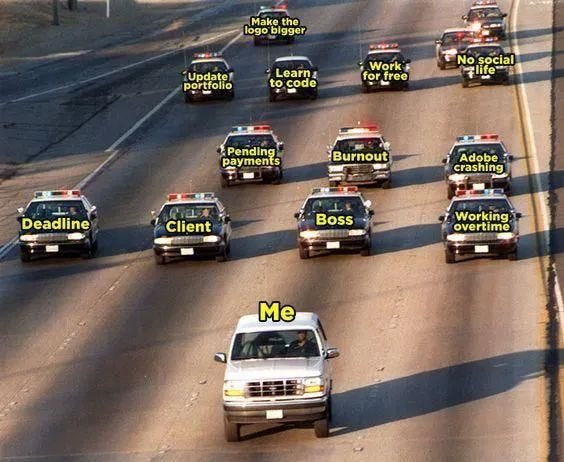
Before you say it: yes, large organisations have genuinely complex approval structures (often to protect their own cash-flow and interest), and no-one expects that to disappear overnight. The point isn’t that process should vanish. It’s that the time it consumes should be acknowledged as real and billable, not a free service the agency provides (at great length) alongside the work.
If the way you work causes extra work for someone else, that’s on you and you need to pay them for it. Otherwise it’s silent labour.
Education Takes Time (and Money)
The same invisible labour shows up again as education. Annie Masciavè, Head of Creative Production at Vinted, was candid: “This constant effort on education takes time. It can pull agencies away from the work itself, and it often goes unbilled. But it is needed to help clients understand the real time, people and expertise required.”

Education turned into expertise looks effortless from the outside. That’s precisely why it goes unpaid. But with AI raising client expectations while simultaneously raising the time and cost of agency up-skilling, the gap is only widening. And the worst part is, people currently think AI = cheaper. When the reality right now is AI = more expensive than ever for agencies willing to do the work and up-skill.
And the cost is hitting forward-thinking agencies hardest, those investing real time and money to stay ahead and make the best work. The kinds of agencies clients should be jumping to work with are the ones that are most at risk if they’re not fairly paid for their efforts.
The speed, cost, quality triangle
If there’s a single image that captures the structural reality underneath all of this, it’s one Paul Austin, Founder of Made Thought, returns to often enough that he often uses this diagram: “I often present this, where a client can only pick two of the three factors: speed, cost, quality. If a client wants great work done very quickly, it will cost more. If they want something fast and cheap, it will affect the quality.”
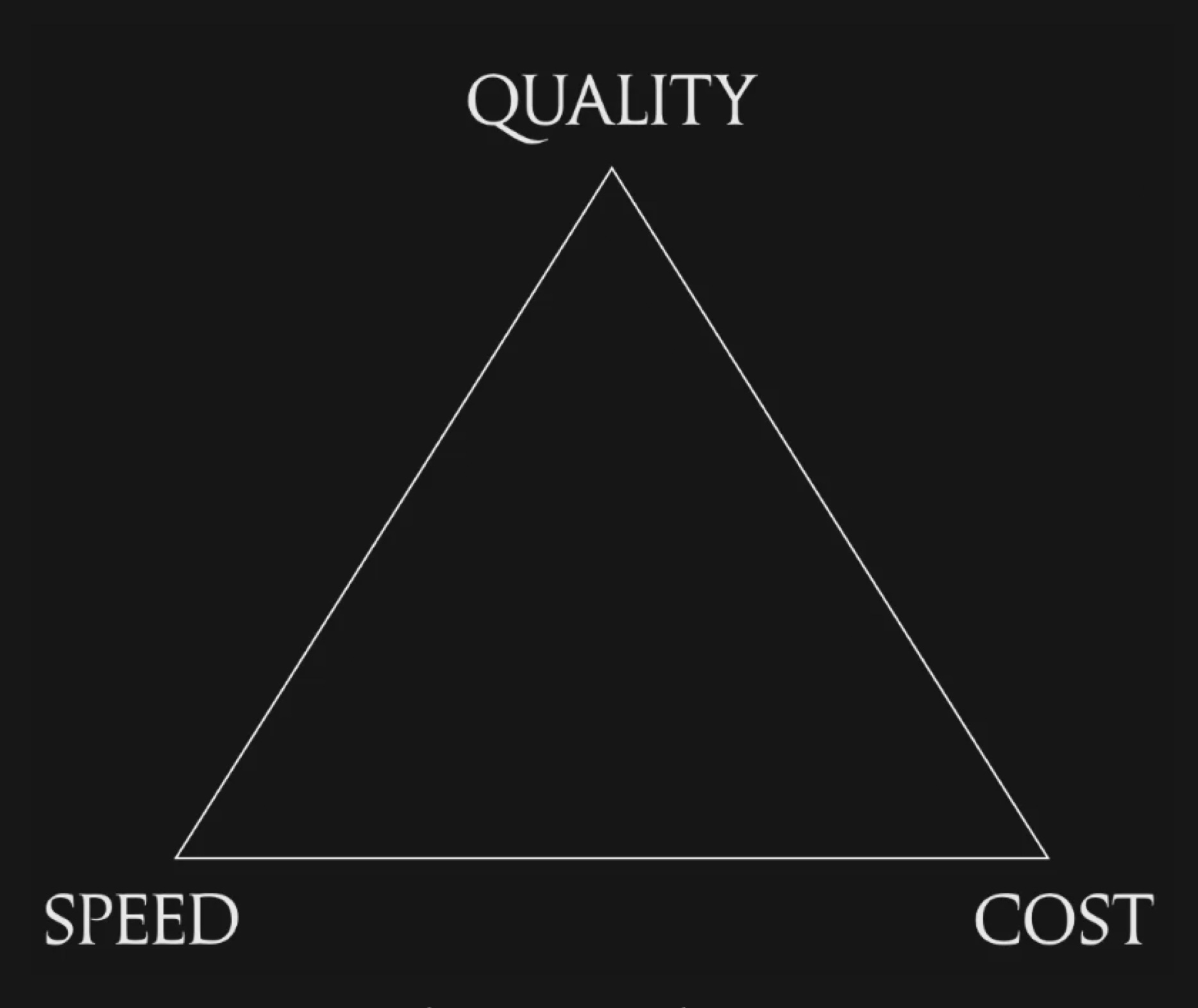
It sounds almost too simple to need saying. Yet the expectation that work should be fast, cheap and excellent simultaneously is, according to this research, one of the most common sources of relationship breakdown. Thomas Kirkby-Jones, Founding Partner of Breaks, named the trend line behind it: “Decreasing budgets, for an increased ask. Never before have we had to do so much with so little.”
This expectation often hides behind a smaller phrase that does a lot of quiet damage: “It’s only for social.” Dani Coyle pushed back directly: “Whether a film ends up on TV, in an email banner, or on social, it still takes the same amount of thinking, crafting and making. The placement doesn’t change the process.” The craft cost is identical. Only the perceived value has shrunk, because the channel has been mentally filed as lesser.
Retainer is a dirty word
One of the shortest answers in this research came from a contributor who asked to stay fully anonymous, whose view of the retainer model was refreshingly blunt: “Retainer is a dirty word.”

It’s a striking thing to hear from the client side, because agencies tend to describe retainers as the opposite: the place trust compounds, where the work gets genuinely good because both sides stop performing for each other. The gap between those two positions is itself a finding and says less about retainers themselves than about how rarely either side checks whether the arrangement is still earning its keep. Until it’s curtains.
Here's the structural problem that needs interrogating: retainer work is almost never evenly distributed. They’re front-heavy when it comes to agency onboarding admin, education, strategising and concepting. Then the heavier lifting tends to peter off. The client starts to look at the “less” they’re getting now vs the “more” they got a few months ago. The agency’s upfront over-delivery goes unseen. And the client feels overcharged in the present. Resentment builds.
The great thing is, neither of them is wrong. In fact, both of them are right. The contract was set up wrong. The work was front-loaded, but the invoices were evenly distributed. The perceived value collapsed in on itself.
A more honest retainer structure might have a higher rate in the first three to six months that accounts for upfront investment, stepping down to a lower ongoing rate once the relationship is established and the agency output levels. Both sides know what they’re paying for at each stage. The value is visible when it’s highest. The cost adjusts when the nature of the work changes.
Scope Transparency
And finally, the moment nearly every agency contributor described as rare enough to be remarkable. Liam S. Gleeson explains: “The best thing a client can do is take ownership when the scope of a project changes. On the rare occasions when a brand is proactive about recognising additional work and ensures it’s fairly reflected in budget and timing, it completely changes the dynamic. That level of trust makes you want to go above and beyond, run through walls, if you like.”
Notice the word rare. The default, on both sides, is to let scope creep happen quietly. The client doesn’t flag the extra ask because asking feels like admitting the brief was wrong. The agency doesn’t push back because pushing back feels like risking the relationship. So everyone absorbs it, and the resentment compounds invisibly until it surfaces in an un-renewed relationship.
Scope creep is a silent killer. Especially when agencies are grappling with margins plummeting whilst overheads skyrocket.
To end, the silent contract can’t survive if it’s named. So name it.
Every clause in it, the unpaid pitch, the absorbed scope creep, the invisible education, the retainer nobody reviewed, persists not because either side wants it to, but because naming it feels riskier than carrying it. It isn't.
The relationships in this research that work, the ones contributors described as genuinely good, are almost always the ones where someone said the thing out loud first. Said the number. Named the constraint. Flagged the scope change before being asked. It costs something to go first. It costs more not to.
The alternative can’t be to squeeze more for less out of agencies in perpetuity. The work, and so client businesses will only suffer. We’re seeing some of this play out already.
Let’s put an end to it.
Here’s where to start…
If you’re a client:
Offer to pay for pitches.
Say the number first. Or factor in the time and cost of going back and forth to find it out.
If the scope changes, say so before the agency has to.
Pay on time. Healthy cash-flow makes for healthy creativity.
If you’re on a retainer, check it’s still working. For both sides. Once a quarter.
If you’re the agency:
Don’t pitch unless you get paid.
Charge for process admin. If it’s light, fees are lighter. If it’s heavy, fees are more.
The first time you name scope creep costs less than the tenth time you don’t.
Itemise education. Even if you choose not to charge for it, make it visible.
Tier your retainer: higher upfront when the work is heaviest, lower once the relationship is established.
And both: agree on the number, agree on the scope, agree on the admin, agree on the process, and agree to keep an open dialogue around the value exchange. The silent contract only runs the relationship for as long as both sides let it stay silent.
Anything we’ve missed out you’d love us to explore or talk about? Let us know in comments.
In case you missed them, the articles that came before today’s in the series are below:
1 – The Brief is Downstream of the Problem: Read here.
2 – Trust is Built, Not Declared: Read here.
3 – Nobody Designed the Process: Read here.
A massive thanks to our contributors:
Frida Hedqvist (IKEA), Alex Tan (MOUTHWASH Studio), Nav Gill (Nike), Nikita Walia (U.N.N.A.M.E.D.), Joel Linkewer (AIRBNB), Isobel Farmiloe (DAZED), Thomas Kirkby-Jones (BREAKS), Mark Carroll (PINTEREST), Andy Harvey (COMMUNION), Mo White (REFY), Damola Oladapo (House Captain), Annie Masciavè (VINTED), Dani Coyle (Intersexy), Luke Li (IKEA), Liam S.Gleeson (HIDDEN and Hi-fi.london), Susie O’Brien (adidas), Lily Fletcher (Broadwick Studios), Lesley Winterbach (The GOODList), Paul Austin (Made Thought), Shanice Mears FRSA (The Elephant Room), Laura Conway (Creative Blood), Ana L, and Munise Can (Highsnobiety).
And a few who wanted to stay anonymous ;)
And special thanks to Lucinda Bounsall of Post-Culture by Sibling Studio – who the series was written in collaboration with.
Subscribe to LOOK-UP.WORLD™, By Morwenna
For 20 years, Morwenna has watched what separates creative businesses that take off from ones that plateau. LOOK-UP.WORLD™ is taking those insights public.