


This is the first article in a five-part series examining the creative industries through the eyes of more than 30 solopreneurs: the freelancers, consultants and Business-of-One operators working with some of the world's most respected brands and agencies. Together, they share sharp observations, advice and insights on what it really takes to go it alone.
WTAF is a Solopreneur?
Picture a solopreneur.
Outsiders will, likely, conjure the following: a laptop and a duvet. Someone who just lost their job, masking as a “consultant”. A lifestyle choice for B-type personalities. A smaller, scrappier, slightly apologetic version of an agency. Someone who doesn’t fit in, “culturally”. A jacks-of-all-trades-masters-of-none. A co-working space, twiddling thumbs and an overpriced matcha latte. People who couldn’t get a “real job”, so they made one up instead.
You judgemental lot you.
“But the internet agrees with me! Type it into Google and the AI summary calls it a ‘lifestyle choice.’” Ahhhh, you got me. If AI says it, it must be right, right? Especially since AI has zero track record of presenting the prejudices of its totally diverse and totally moral, zen-buddha makers.
It’s worth asking who are these social prejudices benefitting? Prejudices that dissuade people from the “social suicide” of entering such a slovenly realm. Not solopreneurs. Perhaps the people at the top who are used to creaming off PAYE staff….?
Calling something a “lifestyle choice” softens the speed-culture-crushing blow and talonous-grip of the cage we’re clawing our way out of to leave. It makes it an “us” problem. Not a “you” problem. As if a structural correction currently pulling in over 4.2 million people in the UK alone were a scented candle and a four-day week.
As we’ll come to learn, solopreneurs are some of the sharpest, hardest working, perspective-rich people in the industry.
“OK, but WTAF is a solopreneur? And why is there suddenly so many of them?”
A solopreneur is a business run and operated by one person, without permanent employees. Why they’re here, and what they can actually offer above and beyond current, very limiting, perception deserves their own sections.
Starting with the why.
Why Are They Here?
To answer that let’s take a walk down systemic lane. Because, if you’re used to traditional roles, traditional structures and traditional ways of thinking, the rise of solopreneurs might come as a bit of a… shock?
The tide has changed. What used to get called “freelancers” has evolved into something else entirely: multi-skilled free-agents with unique perspectives and a killer network of collaborators they can pull in to get a job done with momentum that leaves network agencies and red tape quaking in their boots.
The thing we need to get to grips with is that solopreneurs aren’t a smaller version of an agency. They’re a different kind of business entirely. They can work in brands, they can work in agencies, they can work for themselves. There are 4.2 million of them in the UK alone right now, a figure that’s climbing. And dw if, like Viktor Wendt you didn’t even know you were one…

The government doesn’t seem too familiar with them either.
Enterprise Nation’s research, Britain’s Solopreneur Boom Escapes Official Economic Radar, found UK business sign-ups have doubled on Stripe in just two years, a jump official statistics haven’t recorded. In the report Ernie Tedeschi, Stripe’s chief economist, explained solopreneurship in Britain “is poorly captured by official statistics,” proven by the fact that the 4.2 million figure itself comes from a government study that used to run annually and fell silent after 2024’s rendition.*
[*ʷʰᵃᵗ’ʳᵉ ʸᵒᵘ ʰⁱᵈⁱⁿ’ ᵍᵘᵛⁿᵃ?]
TBF it’s probably easier for the government to get people believing that people are leaving because they’re “not good enough,” rather than admit the system itself is broken.
We’re onto you, Mr. Government.
Why did they leave?
The truth is, many are leaving (myself and the vast majority of this research included) because the systems and structures no longer served them. A salary, post tax, stopped being able to sustain the household, childcare, mortgage, cost of living etc etc. Add to that the negative impact the outdated 9-5s and back-to-back meetings have on parenting, creativity, mental health, and the work itself – and it’s no wonder people are seeking pastures new.
Myriam Cordoba, who is ex Salomon and now consults at Dinamita Studio, explains: “people are fleeing” traditional PAYE workspaces and the “people that are staying are suffering.” She goes on to say she has “seen so many friends burning out”.
Rhianna Cohen, Creative Director of No Ego agrees that the structures are no longer fit for purpose and, as a result, has worked hard to set boundaries that prevent her from being “forced to work into a business structure that doesn’t serve the work.” The usual culprits, in her words: “compressed timelines, endless check-ins, no time to think, endless meetings, all the things that compromise good creative work.”
People are fed up, sick of working inside a pyramid scheme with better branding, and seeking creativity and purpose.
Emily Clay, founder of Clay Studio, and Lola Hoad, founder of Good Call Studio, are good examples of people who’re rejecting old models in favour of building something with purpose. Emily wanted “to eventually create a small-scale creative agency where women feel valued, have flexibility in their schedules, especially around motherhood, aren't expected to burn themselves into the ground, and have the opportunity to create beautiful, purpose-driven work."
Lola holds her clients to a standard “upheld by the notion of crafting good brands for good people doing good things,” a purpose that goes beyond “wanting to contribute to over-consumption and over-consumerism.” She also explains the benefits of setting up: “systems and processes that are built around a founder’s energy” and how these “will always outperform systems and processes that have been copy-and-pasted from someone else’s way of building.”
In short: the best talent is leaving in pursuit of creativity, morals and purpose. So grinding that down, as we’ve done, to several million lazy people who fancied a bit more duvet-based laptop time is quite the gaslighty switcheroo.
Solopreneurs are not less than. They are, quite literally, the definition of more than: more than one title, more than one area of expertise, more than one interest.
Perspective is everything
So why are solopreneurs so great? And why is it high-time we changed the way we value them, work with them and pay them?
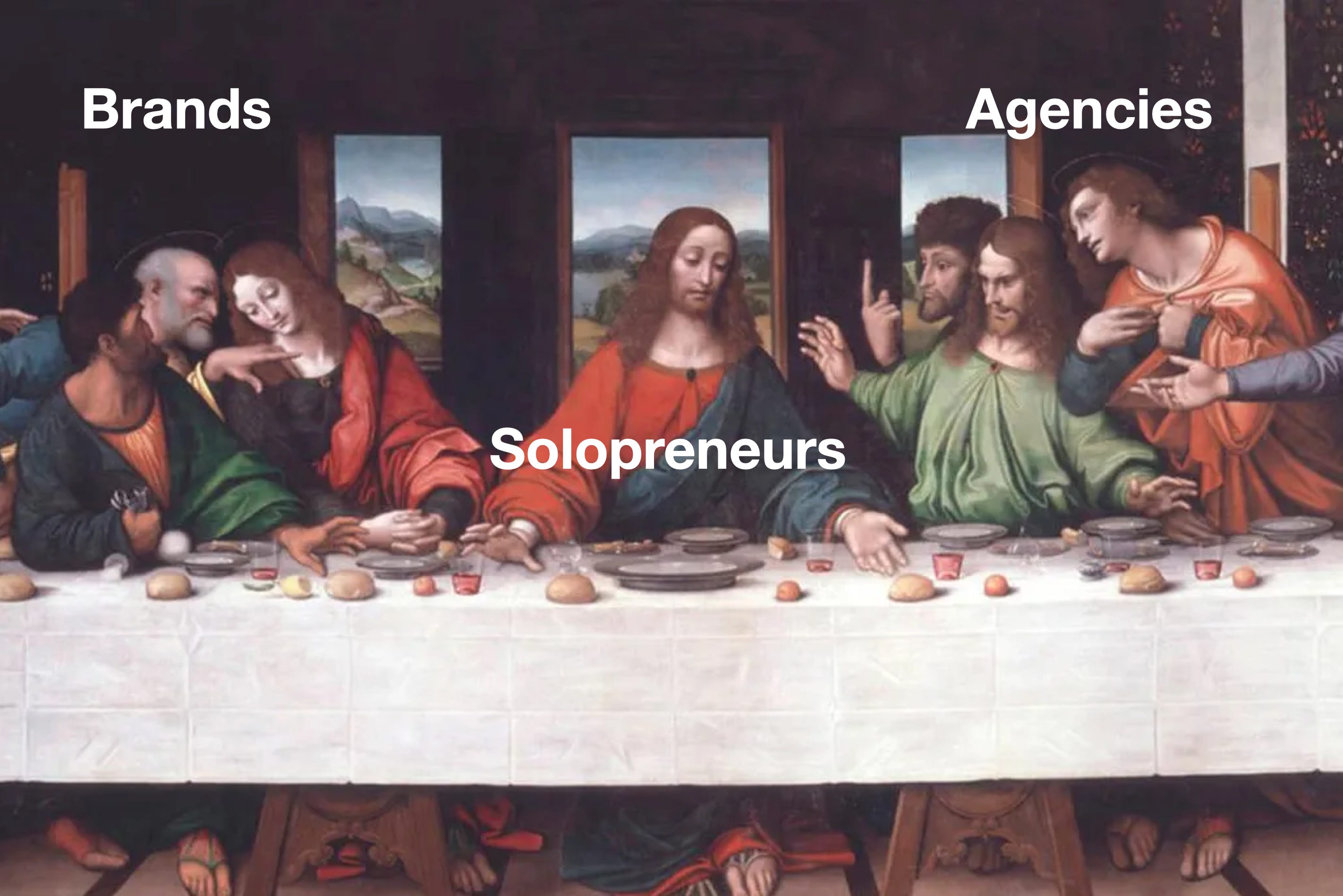
Well, firstly, as I called out in last week’s series intro What It Takes To Go It Alone their perspective is next-to-none. No one else can claim to see and experience both brand and agency strengths and weaknesses, and the industry at large with more clarity: “Solopreneurship’s all-seeing, all-hearing, and, increasingly, all-knowing eye is a growing influence, with simmering potential.”
Solopreneurs didn’t leave blind. Quite the contrary. If anything, they know too much. They’ve broken bread with both sides of the table. Yet they’re still treated like an appendix, offered the high-chair, or put on a separate table entirely.
As traditional industry models continue to shift and dissolve, the connective tissue solopreneurs represent, and the 20/20 vision that comes with it, will only put them in better and better stead. Something worth paying a premium for, if you ask me…
Premium product, premium pricing.
Being the wrong shape for a system that’s showing its first signs of crumbling is, as it turns out, a blessing. Thinking across lanes instead of staying inside one is no longer a liability, it’s a premium. The outcasts are becoming icons. And the creative industry needs to catch up.
We're entering the era of what Rhianna names "the rise of the end-to-end thinker," someone who can "think strategically, make creatively and use new tools to move an idea from zero to something real," entirely on their own terms.
The benefits of being a solopreneur, she describes, is becoming "disgustingly good at just getting on with it. There's no chain of seven people waiting for someone to move a logo 2mm. You can go from strategy to creative to rollout without the thought getting lost somewhere around stakeholder number four. My friend TJ recently taught me that the quote 'jack of all trades, master of none' doesn't end there; it actually ends with 'often better than master of one'. “The generalists are in their revenge era.”
Eugene Healey, Co-Founder of The New Fundamentals of Brand at Studio EH, doesn’t call himself a solopreneur at all, despite running exactly the kind of business this series is about, precisely because the perspective shift on their value hasn’t hit yet. “I would worry that ‘solopreneur’ is read by clients as ‘we can charge them less’,” he told us. “You’re seen as labour. When it comes to consultancy, you’re capital. Pricing is theoretically infinite.”
Labour gets paid for in time. You clock in, you clock out, the invoice reflects the hours. Capital gets paid for outcome: the direction only you could have arrived at. “People are willing to pay for a direction […] that somebody else cannot help them arrive at, that will deliver them outsized returns,” Eugene said.
Kathryn Clarke, Founder and Creative Recruiter at Re.source, put infinite pricing into action, explaining that solopreneurs can: “charge a project fee for double [their] old monthly salary and have someone just say yes.” That’s the actual mistake solopreneurs make at the start: carrying an employee’s sense of their own value into a market that requires so much more of them structurally.
Because when we look at the set-up costs of a Business-of-one vs the increasingly “flexible” set-up of independent studios and agencies, there doesn’t seem to be much in it anymore. As I explained on my LinkedIn recently:
Nobody warns you how much invisible infrastructure being a solopreneur requires. An accountant, a lawyer, a support network, project collaborators, a co-working space, always-on new business and marketing... all of it assembled from scratch, one relationship at a time. Sounds pretty familiar to the set-up costs of a small creative studio... no? Yet brands and agencies that work with solopreneurs still position them as “less”. And so pay them less. Leaving solopreneurs (and their futures) to pick up the bill.
What hasn’t kept pace is the support around them. They’re no longer auto-enrolled, like their PAYE counterparts, into anything resembling the old welfare state: a legal pension, the right to rest (aka holiday), the right to recover (aka sick pay), NI, PAYE, private healthcare. That used to come systemically attached to a job. Going alone means building all of it yourself, or going without. And because they’re priced as “less”, the profits left over to fund it themselves often aren’t there either, which will only come back to bite us later on.
The market needs to catch up and start paying solopreneurs fairly.
Partnerships x Solopreneurship
Partnerships was the third ‘P’ that makes solopreneurs triple threat.
It turns out that network that’s long been given away for free (in answer to “oh, do you know anyone good for X?”) is part of the offer itself. It’s time to monetise your network, chaps.
One of the best things about being a solopreneur is you can, as James Davis, Founder of BOX EYE Studio and Drawn Distant , described “actually build the right team for a brief.” Because “not every brief suits every fixed team, having a fluid one means you can pull the right expertise for the right job.” The old model offered you one team, permanently, whether it fit or not. This newer (dare I say better?) model gets you higher grade talent, so higher grade creativity.
Letty Cole, writer and Founding Editor at Lost Property, calls this: “flexibility of the mind” (not the flexibility of a four-day week). The flexibility that lets perspective move between contexts instead of calcifying inside them. It open-sources the references. Welcoming in new people, perspectives and potential outcomes. All to the benefit of the work.
P.S. we’ll be exploring how to monetise your network in later articles. Follow along to find out.
To end…
WTAF Is A Solopreneur, then?
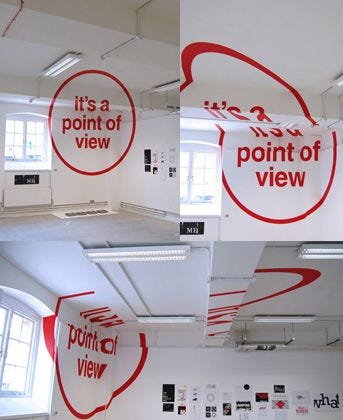
Literally, it’s a business set up and run by one person without permanent employees. But their USP is perspective. A point of view nobody else has. And a team of specialised, ever changing collaborators bought in to execute it with pin-point accuracy.
Solopreneurs are the people who got filtered out of a hiring process because they were un-pin-downable. The people who can think differently. A trait that, in the age of AI, is only growing in premium.
The best thing about them is that they rejected the system. That gives them trojan horse knowledge: they know exactly what’s wrong with the old model from the inside, because they lived it, which makes them well positioned to build something better, particularly because their motives aren’t selfish, they’re rooted in the pursuit of better creativity, morals and purpose, which, surely, is the end goal for any business.
…
Right?
What’s to come
Now we know what a solopreneur actually is, we'll follow the lifecycle of one start to finish using insights from 30+ of the best in the industry (full list below, take a look – it’s a goodie). We’ll explore how to set the business up, win the work, get the job done, and get paid. And dig into all the good, bad and ugly bits in between. So we can co-author a better route forward together.
Along the way we’ll explore why operating solo might be costing you money. Why interviews became unpaid pitches in disguise. Why being small keeps getting mistaken for being less. Why your network is worth its weight in gold, as well as sharing a case for treating solopreneurs as equals.
We hope you enjoy reading it as much as we did writing it! Speak again in 2 weeks!
💙
Thanks to our exceptional contributors
Without whom this series wouldn’t have been possible:
Eugene Healey (The New Fundamentals, EH Studio) James Davis (BOX EYE Studio , Drawn Distant), Viktor Wendt (Substanz), Rhianna Cohen, Ollie Oshodi, Emily Clay (Clay Studio), Letty Cole (Lost Property), Michelle Blaser ( The Pollinatr), Alex O’Brien (Studio AOB), Elif Albayrak (Cartel-agency), Penny Rankin (Public Figures), Lynn Juang (Frameworks Consulting), Fabi Pacini (Pamela Studio), Amy Becker (Becker Creative Operations), Ashley Mi Ki Mak, Kristen Nicole Adeyemi, Lola (Good Call Studio), Avesta Keshtmand, Chloe Perkins (The Creator Cupid), Flora Dalton, Holly Hay (ANNIKA), Kathryn Clarke (Re.source), Marie Bliss Delpy (Studio M.B.D), Matt Sav, Myriam Córdoba (Dinamita Studio), Ray Hopkinson (Swayed Studio), Rumi Josephs,
Work with the LOOK-UP.WORLD™ by Morwenna
Hi I’m Morwenna, founder of LOOK-UP.WORLD a Growth Partner to creative businesses. If you like my writing, here’s how we could work together:
Growth Consultancy
Vision for Growth (strategy)
Path to Growth (execution)
Get in touch: morwenna@look-up.world / LinkedIn
Keep Reading
The Future Client Does Not Exist

Before we dive headlong into the brand-agency-future stuff, I want to end the series by examining the most important question of all:
Nobody Designed the Process

Think about the last time a creative project felt smooth. Where the brief was water-tight upfront, consolidated feedback arrived early, freelancers were put to full use, invoices were paid on time and the creative output outdid the concept.
If AI can do the output, what are you selling?

This article is going to feel a little different. The first five pieces diagnosed the problem from every angle: briefs written too late, trust unprioritised, processes nobody designed, silent contracts, unpaid labour, and unethical habits around pitching. That was the diagnosis. This is the prescription.
Subscribe to LOOK-UP.WORLD™, By Morwenna
For 20 years, Morwenna has watched what separates creative businesses that take off from ones that plateau. LOOK-UP.WORLD™ is taking those insights public.
Wow. A brilliantly empowering article. Perspective is a great angle. We’re told to niche down but that just cuts off the air supply to everything I love that helps to build a much broader view of the world.
This captures the ecosystem of soopreneurs fantastically. We are living through the equivalent of the Industrial Revolution in terms of career paths; the future is Solo!
PS: The choice of memes is exquisite ✨